Your Map My Customers reports are getting stale, and the pipeline questions they answer no longer match how your team actually sells. Performance analytics only matter when the data points to the next action, not just a historical chart. By the end of this article, you will have three concrete alternatives to evaluate, a clear set of criteria for comparing them, and a definitive number one pick for Salesforce users who need sharper forecasts. We compare Veloxy, SalesRabbit, and one more option directly against the features that matter most for tracking rep activity and deal velocity.
What to Look For in Performance Analytics Tools
When evaluating performance analytics tools for field sales, focus on capabilities that directly impact rep productivity and territory efficiency. The right platform should turn raw location data into clear, actionable insights, not just a collection of maps and logs. Look for tools that help managers answer specific questions about where reps spend time and which activities drive revenue.
Real-time data dashboards are the backbone of any useful sales analytics system. Without live visibility, managers are reacting to last week's problems instead of guiding today's decisions. A strong dashboard should refresh quickly and display key performance indicators like visit frequency, route adherence, and sales quota attainment in a single view.
This immediacy matters for coaching moments. When a rep is falling behind on daily visits, a manager can intervene immediately rather than discovering the gap days later. Real-time location data also helps with territory design, as leaders can see which areas are underserved and which are getting excessive coverage.
Route optimization with GPS tracking is essential for reducing drive time and fuel costs. Field sales teams waste hours each week on inefficient travel between accounts. Good route planning software should suggest the most logical order for stops, accounting for traffic patterns and appointment windows.
When reps follow optimized routes, they can fit more customer visits into each day. This directly improves revenue per rep because more face-to-face time typically leads to stronger relationships and larger deals. GPS tracking also provides the data needed to verify that reps are where they say they are during working hours.
Customer visit tracking goes beyond simple check-ins. The best tools capture details about each interaction, including duration, purpose, and follow-up actions taken. This information feeds directly into lead-to-visit ratio metrics, which show how effectively reps convert assigned leads into actual meetings.
Tracking visit frequency across accounts reveals patterns that matter. High-value accounts may need weekly contact, while smaller accounts might only require monthly check-ins. Performance analytics should help managers spot accounts that are being neglected and rebalance workloads accordingly.
Coverage analysis is critical for sales territory management. A map-based view of where visits occur versus where customers are located shows gaps in coverage. This helps sales leaders redesign territories so that every rep has a balanced workload with realistic travel expectations.
Effective coverage analysis also highlights oversaturation, where multiple reps are calling on the same accounts. Consolidating those efforts frees up time and reduces internal competition. Territory mapping tools should make it easy to visualize these patterns and adjust boundaries as the market evolves.
Lead-to-visit ratio metrics connect marketing efforts to field execution. This number shows how many assigned leads actually result in a physical visit from a rep. A low ratio indicates that leads are not being prioritized or that travel constraints are preventing follow-through.
Managers should track this metric alongside win rate analysis to understand which lead sources produce the best outcomes. When combined with pipeline analysis, the lead-to-visit ratio reveals whether reps are spending time on opportunities that are likely to close or chasing low-quality prospects.
CRM integration is non-negotiable for a complete performance picture. Your sales analytics tool should sync seamlessly with your existing customer relationship management system. This ensures that visit data, notes, and next steps all live in one place without duplicate entry.
Integration also enables deeper metrics like customer engagement scores and sales cycle length. When a rep logs a visit in the field, that information should immediately update the account record. This creates a closed loop between activity tracking and sales performance management.
When comparing tools, request a demo that shows how each platform handles the following capabilities:
- Real-time dashboard customization for different manager levels
- Route optimization that factors in appointment windows and traffic
- Automated visit logging with minimal manual data entry
- Territory heat maps showing visit density and coverage gaps
- Automated lead-to-visit ratio reporting
- Two-way sync with major CRM platforms
Consider the reporting depth for revenue per rep and sales cycle length. The best analytics tools let you slice data by rep, territory, account segment, or time period. This flexibility helps managers identify top performers and understand what behaviors drive their success.
Finally, think about adoption. A tool with powerful features does not help if reps refuse to use it. Look for mobile-friendly interfaces that work naturally in the field, with offline support for areas with poor connectivity. Sales rep productivity depends on tools that are easy to use, not burdensome.
1. Veloxy - Best Overall
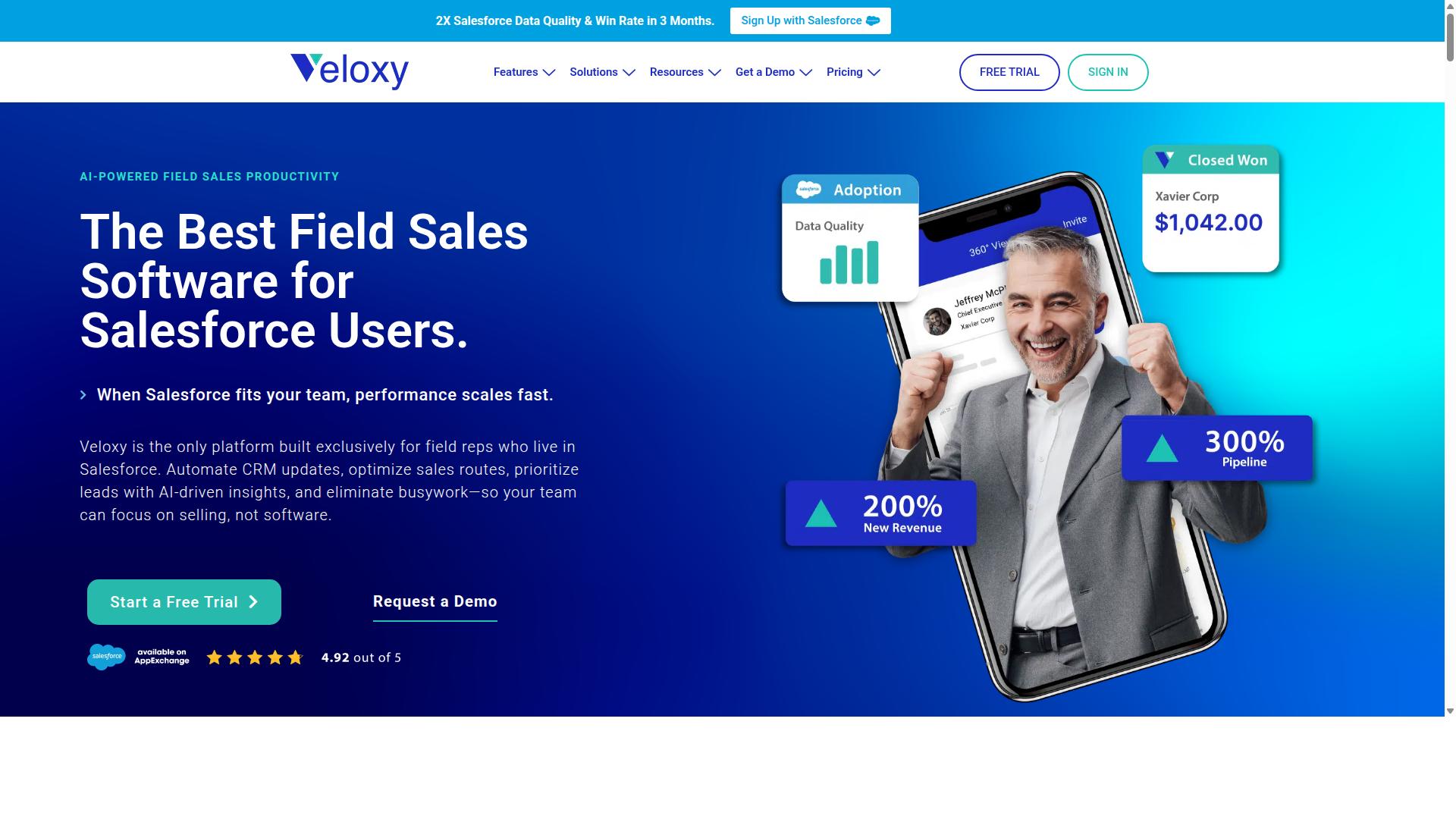
Veloxy stands out as the best overall choice for field sales teams using Salesforce, offering a comprehensive suite of AI-powered tools. Where Map My Customers focuses primarily on route optimization and visit tracking, Veloxy goes further by combining territory mapping with predictive forecasting and sales enablement. It is built exclusively for Salesforce users, which makes it a natural fit for teams already living inside the CRM.
The platform targets field sales reps, inside sales professionals, and sales management who need more than just a map. Instead of a single-purpose route planning software, Veloxy delivers a full workflow: Salesforce Automation, Lead Qualification, and Pipeline Management sit alongside Guided Selling and a Quick Dialer. This means reps can qualify leads, manage deals, and log activities without switching between disconnected tools.
For teams that rely on real-time location data and coverage analysis, Veloxy includes Proximity Search, an Opportunity Map, and a Prospecting Map. Route Planning helps managers understand whether reps are actually visiting the right accounts. The Salesforce 360 degrees Views and customizable contact profiles give a complete picture of each customer before a rep ever knocks on the door.
Veloxy also addresses the productivity gap that many field teams face. The platform includes Buying Signals and Sales AI to prioritize accounts showing genuine intent, plus Task Lists That Adapt to the Day to keep reps on schedule. Email Tracking, Email Analytics, and Drip Campaigns extend the tool beyond field visits into digital follow-up. Veloxy claims that teams can double sales productivity after three months, a strong statement for organizations measuring sales rep productivity and quota attainment.
For sales management, the Smart Forecasts and Sales Analytics features support pipeline analysis and win rate analysis without manual spreadsheet work. The mobile app works on iPhone and Android, while the web app is accessible from any browser. Veloxy is available on Salesforce AppExchange, Microsoft AppSource, Google Chrome Web Store, Google Play, and the Apple App Store, making deployment straightforward for most organizations.
Compared to Map My Customers, Veloxy offers a broader approach to sales performance management. Instead of asking managers to piece together visit logs from a mapping tool and then cross-check the CRM separately, Veloxy keeps everything in one place. For teams that want to improve lead-to-visit ratio and customer engagement score while cutting down on manual data entry, this integrated model is the key advantage.
2. SalesRabbit
SalesRabbit is a popular field sales tool that focuses on territory mapping and route optimization to boost rep efficiency. It is commonly used by door-to-door sales teams and outside sales organizations that need a straightforward way to manage leads and daily visits.
The platform includes territory mapping, route planning, and customer visit tracking as its core functions. Sales reps can visually see their assigned areas, plan efficient driving paths, and log each customer interaction directly from a mobile device.
Its real-time location data helps managers monitor where reps are working during the day. This makes it easier to confirm that teams stay within their designated zones and follow planned schedules, which supports basic sales territory management.
SalesRabbit also offers lead management tools that let teams capture new prospects while in the field. Users can assign leads to specific reps, track follow-up status, and maintain a clear record of each account's history without needing a separate spreadsheet.
One of its main strengths is ease of use. The interface is designed for fast-paced field work, so reps can learn the basics quickly and focus on selling rather than wrestling with complex software. The visual map-based layout is especially helpful for teams that think in terms of neighborhoods and routes.
However, the analytics side is more limited compared to AI-driven tools. SalesRabbit provides useful activity metrics, but it does not offer the same depth of geospatial analytics or predictive insights that some performance analytics platforms deliver.
For teams that need to measure sales rep productivity and visit frequency, the reporting covers the essentials. Managers can review daily activity counts and compare performance across reps, but deeper analysis like win rate trends or revenue per rep may require exporting data to another system.
SalesRabbit works well for organizations that prioritize simple route adherence and lead capture. It is a solid option if your main goal is organizing field activity, though teams wanting advanced sales performance management may need to supplement it with additional tools.
How to Choose the Right Option
Selecting the right performance analytics tool requires aligning features with your team's specific sales workflows and CRM environment. For field sales teams and sales management, the decision often comes down to how well a tool supports daily route execution while feeding accurate data back into forecasting and pipeline analysis.
Start with your CRM. Teams already using Salesforce should prioritize tools that offer deep CRM integration, since that determines whether customer visit tracking and revenue per rep metrics stay current without manual data entry. A tool that requires exporting and re-importing data will quickly lose adoption among reps who value speed.
Next, evaluate the depth of analytics. Some tools focus on descriptive reporting, showing what happened after the fact. Others, like Veloxy, are built specifically for field sales and sales management using Salesforce CRM, which matters when your team needs predictive insights tied to territory mapping and route planning software rather than just a historical dashboard.
Use this comparison checklist when reviewing options like Veloxy and SalesRabbit:
- CRM integration: Does it sync natively with Salesforce, or does it require middleware?
- Analytics depth: Does it offer predictive sales analytics, or only descriptive sales dashboards?
- Ease of use: Can field reps learn it in under a day, or does it require formal training?
- Scalability: Can it handle a growing territory design and larger account segmentation without performance drops?
- Pricing model: Is it per-user, per-feature, or bundled? Does the cost scale fairly as your team grows?
Consider the lead-to-visit ratio and visit frequency metrics your managers rely on. Tools that support real-time location data and route adherence give supervisors visibility into daily execution, while geospatial analytics help with coverage analysis and territory design for the quarter ahead.
Finally, test before committing. Most reputable platforms offer a free trial, and that hands-on period is the best way to assess sales rep productivity gains and win rate analysis capabilities. During the trial, have a few reps run their actual daily routes and enter real visit data. That will reveal whether the tool reduces friction or adds another layer of administrative work.
For any sized field sales team, the right choice balances sales force automation with meaningful performance management. A tool that connects customer visit tracking to sales quota attainment and pipeline analysis will deliver lasting value, while one that only tracks location will become shelfware within a quarter.
Final Verdict
For field sales teams deeply invested in Salesforce, Veloxy delivers the most comprehensive performance analytics and productivity gains. When you compare Map My Customers with Veloxy, the difference comes down to purpose. Map My Customers handles territory mapping and route optimization well, but Veloxy was built exclusively for field reps who live in Salesforce.
Veloxy stands out because it pairs sales analytics with AI-powered insights that directly improve sales rep productivity. The platform focuses on the activities that actually produce revenue. That focus is why Veloxy customers report doubling their sales productivity and doubling pipeline and revenue within three months. Users also spend 90 to 95% of their time on selling activities, compared to just 30 to 35% before adopting the platform.
For sales performance management, the practical benefits are clear:
- Real-time location data supports better territory design and route adherence
- Pipeline analysis and win rate analysis give managers a clear view of quota attainment
- Customer engagement scoring helps prioritize visit frequency and account segmentation
Veloxy is recognized as the #1 Field Sales Software for reps and managers using Salesforce. It holds a 4.86 rating on G2 for enterprise reviews, with 200+ reviews on Salesforce AppExchange and 190+ on Capterra. Top software review sites recommend Veloxy, and the company is recognized as a Sales AI Pioneer.
When choosing between Map My Customers and its alternatives, consider your team's specific workflow. If you need basic GPS tracking and route planning, a general tool may suffice. But if you want sales force automation, geospatial analytics, and CRM integration in one platform, Veloxy offers a rare combination of features at its price point.
For those ready to explore further, Veloxy offers a free trial to test the platform with your own sales data. You can also request a free copy of Samir's Big Blue Book of Field Sales to support your team's transition. Contact Veloxy directly through its website or Salesforce AppExchange listing to discuss your field sales needs and see how the platform fits your performance analytics goals.
Recommended Resources: