You hit every goal and still feel like something invisible is steering the wheel. The culprit is rarely effort, discipline, or strategy. It is the automatic programming running beneath your awareness, quietly shaping your decisions about money, work, and worth.
This article explains what mindset shift coaching means, how Eli Bowman uses NLP-based reprogramming to change unconscious patterns, and which formats fit your life: coaching, speaking, retreats, or the 75Mind program. You will also see pricing, credentials, and who this work genuinely suits.
What Is Eli Bowman and What Does Mindset Shift Coaching Mean?
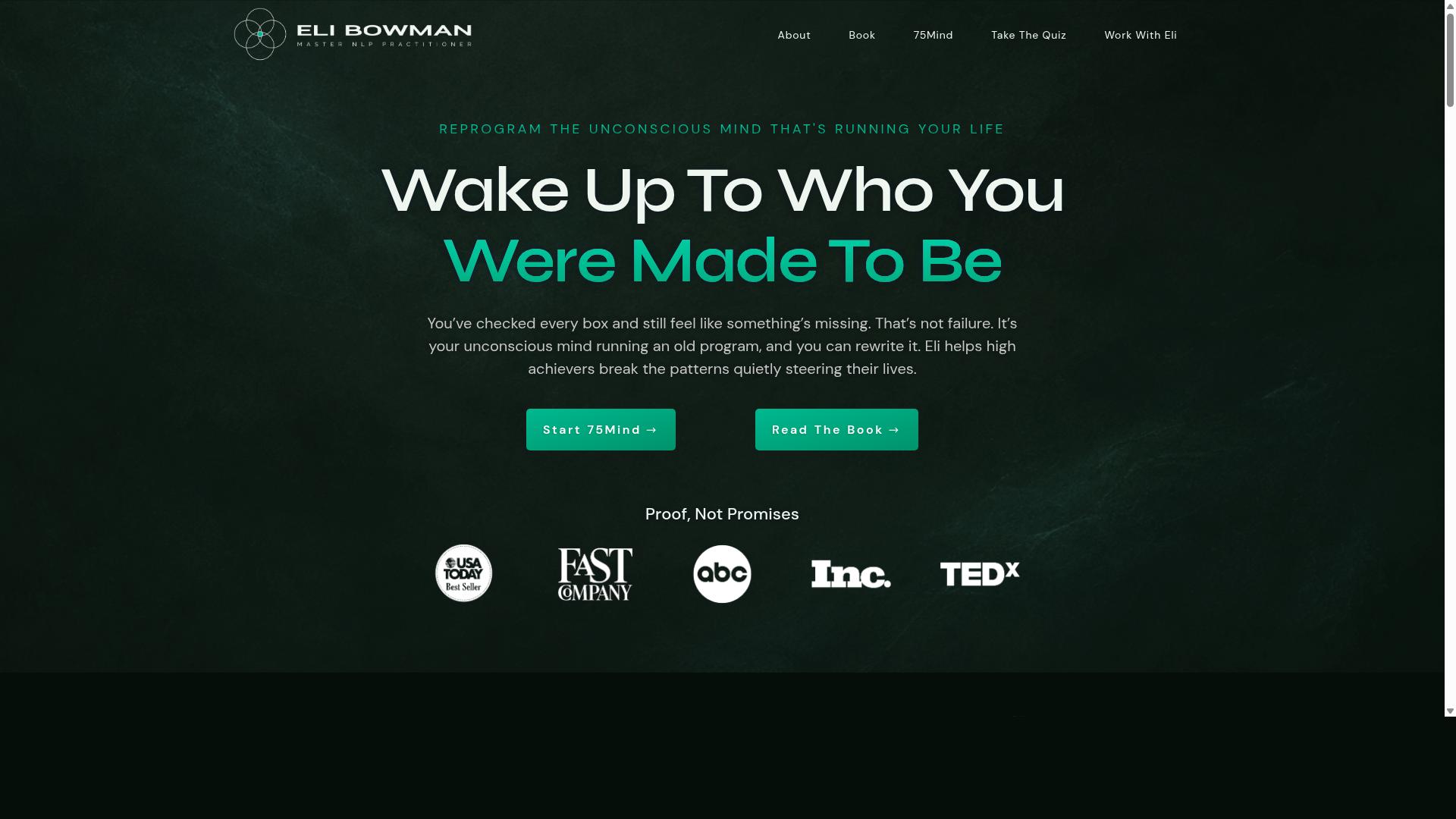
Eli Bowman is a mindset keynote speaker, author, and NLP coach who helps high achievers break the unconscious patterns that quietly steer their lives. His work centers on one core idea: lasting change rarely comes from surface-level advice. It comes from reprogramming the unconscious mind.
Mindset shift coaching, in this framework, is the process of identifying and rewiring the unconscious patterns that drive behavior. It is not motivational pep talks or vision boards. It is structured inner work that targets the root of limiting beliefs, automatic reactions, and habit loops.
Bowman brings this approach to readers and audiences through several channels. He offers coaching, speaking engagements, retreats, and a 75-day mindset program called 75Mind. The brand is operated by Movement Maker LLC, and each offering serves a different depth of engagement, from a single keynote to an immersive multi-week process.
The distinction matters. Many personal development programs hand people new strategies while leaving old wiring untouched. Bowman's method works in the opposite direction, addressing the deep conditioning underneath the behavior first. When the underlying pattern changes, new habits tend to hold instead of collapsing under pressure.
This article explores how that process works, who it serves, and why it produces the kind of behavioral transformation that surface techniques rarely deliver.
Who Eli Bowman Helps: High Achievers Stuck Despite Checking Every Box
Many high achievers reach a point where external success no longer satisfies them, yet they can't pinpoint why. The promotion arrived. The income grew. The goals were met. And still, something feels off.
This is the audience Eli Bowman serves: people who have checked every box and still feel a quiet emptiness. Their resumes look complete. Their inner experience tells a different story.
Common struggles in this group include:
- Self-sabotage that appears right before a breakthrough
- A career or income ceiling that repeats no matter how hard they push
- Vague restlessness that no achievement seems to resolve
- A search for clarity on purpose that strategy alone hasn't answered
Consider an executive who hit every target for a decade, then felt flat after the biggest win of their career. Or a founder whose revenue keeps stalling at the same number despite new tactics each year. These are not effort problems. They are pattern problems.
Bowman also works with organizations looking for speakers, retreats, or ways to bring this work to their teams. The common thread across individuals and teams is the same: capable people whose results are capped by something they cannot see.
The Core Premise: Why 90-95% of Your Patterns Live in the Unconscious Mind
Bowman states that 90-95% of everything you do, feel, and decide is controlled by the unconscious mind. In other words, most of what you do each day runs on autopilot, not conscious choice.
This is not a flaw. It is efficiency. The brain automates repeated behaviors to conserve energy, which is why automatic reactions feel instant and effortless. The problem arises when those automated patterns were formed by old experiences rather than current goals.
Two concepts explain how this works:
- Neuroplasticity: the brain's ability to rewire itself through repeated experience
- Deep conditioning: the layering of beliefs and responses built up over years
Because these patterns live below conscious awareness, willpower alone rarely dislodges them. A person can sincerely want to stay calm under pressure while a habitual stress response hijacks their performance in the moment. The intention is conscious. The reaction is not.
This is why self-awareness and metacognition are starting points, not finish lines. Seeing a pattern is useful. Reprogramming it requires working at the level where it was formed. That is the premise behind Bowman's coaching, his speaking work, and the 75Mind program: change the unconscious pattern, and the behavior follows naturally.
How Eli Bowman Helps High Achievers Change Unconscious Patterns
Eli Bowman's approach combines NLP techniques with a neuroscience-based understanding of how the brain rewires itself. The starting point is a claim he repeats often: 90-95% of everything you do, feel, and decide is controlled by the unconscious mind. If that figure is even close to accurate, then willpower and positive thinking are working on a tiny fraction of the machinery.
That is why his coaching is not motivational in the usual sense. High achievers rarely need more ambition. They need to find the unconscious patterns that keep producing the same results no matter how hard they push.
Bowman brings a specific background to this work. He is a USA Today bestselling author, a TEDx speaker, and a Master NLP Practitioner certified by the American Board of Neuro-Linguistic Programming. He also spent nearly 20 years building companies, some of which failed before the successful ones. Learning how the unconscious mind works changed his approach, and that discovery is what he now teaches.
The goal is behavioral transformation, not temporary inspiration. A client might leave a seminar feeling fired up and revert within a week. Bowman's method targets the deeper layer, the belief systems and automatic reactions that generate the behavior in the first place. Change that layer, and the new behavior holds without constant effort.
NLP-Based Reprogramming: The Method Behind the Mindset Shift
Neuro-Linguistic Programming (NLP) is a set of techniques that aims to change the associations and reactions stored in the unconscious mind. The premise is straightforward: repeated experiences create neural links between a trigger and a response. Those links become fast, automatic, and invisible to the person running them.
Bowman applies NLP techniques in his mindset shift coaching:
- Anchoring: linking a chosen emotional state to a physical cue so it can be accessed on demand
- Reframing: changing the meaning a client assigns to an event, which changes the emotional charge attached to it
- Pattern interruption: breaking a habitual sequence before it completes, so the automatic reaction loses its grip
These tools matter because limiting beliefs rarely announce themselves. They show up as a hesitation, a deflected compliment, or a proposal that never gets sent. NLP gives the coach a way to surface the pattern and work on it directly rather than talking around it.
Bowman's certification as a Master NLP Practitioner, granted by the American Board of Neuro-Linguistic Programming, means he trained in these methods at an advanced level. He pairs them with a neuroscience-based framing, so clients understand why the techniques work, not just how to perform them.
The result is subconscious reprogramming that fits the way the brain actually updates: through repetition, association, and emotional relevance. This is why the work tends to produce an identity shift rather than a temporary mood change.
From Self-Sabotage and Income Ceilings to Clarity on Purpose
Self-sabotage often manifests as procrastination, perfectionism, or an inability to ask for what you're worth. High achievers are not immune to these patterns. In many cases, their competence masks them. The work keeps getting done, just never at the level the person is actually capable of reaching.
Three patterns come up repeatedly in this kind of transformational coaching:
- Self-sabotage: missed deadlines, endless polishing, or withdrawing right before a breakthrough
- Income ceilings: earning plateaus that persist despite skill, effort, and market demand
- Loss of purpose: hitting goals that once mattered and feeling nothing when they arrive
Each of these has an unconscious driver. A perfectionist may be protecting against criticism absorbed early in life. Someone stuck at a revenue plateau may be carrying a belief that visibility is unsafe. The inner critic is often doing its job too well, guarding against a threat that stopped being real years ago.
Bowman's role is to help clients identify that driver and replace it with a belief that supports where they want to go. This is where a fixed mindset gives way to a growth mindset, not as a slogan but as a lived shift in how the person responds to risk and feedback.
The same mechanism addresses burnout prevention and resilience building. When the stress response is tied to an outdated threat, the body stays on alert long after the danger has passed. Rewiring that association restores capacity. Clients report clearer decisions, steadier energy, and a sense of purpose that no longer depends on the next achievement.
Ways to Work With Eli Bowman: Coaching, Speaking, Retreats, and 75Mind
Eli Bowman offers multiple pathways for individuals and organizations to engage with his work, from one-on-one coaching to live events. Each format targets the same core goal: helping high achievers recognize and rewrite the unconscious patterns that quietly cap their performance. The right fit depends on how much personal attention you want, how you learn best, and whether you prefer private work or a group setting.
What ties all four options together is a focus on subconscious reprogramming rather than surface-level motivation. High achievers often arrive with strong discipline and still hit an achievement plateau, because the real constraint sits below awareness. Bowman's formats are built to surface those hidden belief systems and habit loops, then replace them through structured practice.
Here is what each pathway involves and who tends to benefit most.
One-on-one personal coaching sessions offer the most tailored route. In private sessions, Bowman helps clients identify specific unconscious patterns, limiting beliefs, and automatic reactions that drive self-sabotage or recurring emotional triggers. This format suits executives, founders, and performers who want confidential, personalized insight and are ready to examine their own deep conditioning honestly. If you have tried generic personal development content and found it too broad, individual work narrows the focus to your exact patterns.
Keynote speaking brings the same ideas to a room. Bowman speaks at events, delivering the mindset shift framework to audiences who need a shared language for behavioral transformation. This works well for companies, conferences, and teams that want to spark a growth mindset conversation at scale. It is best for organizations looking for an introduction to the material rather than deep individual work.
Retreats and live experiences combine teaching with immersion. Extended time away from daily routines gives participants space to practice self-awareness and metacognition in a supported setting, which is hard to replicate through video alone. These suit people who learn by doing and want momentum built through shared accountability.
The book and 75Mind program extend the work into daily practice. Bowman's book, The Program, is a USA Today bestseller on reprogramming the unconscious mind. 75Mind is a 75-day mindset program built on eight daily habits:
- Track sleep
- Morning gratitude practice
- Meditation or prayer
- 30 minutes of intentional physical movement
- At least 30 minutes of focused reading
- Daily social accountability
- Drink 100 oz of water
- Evening journal entry
The program includes a participant guide PDF, a phase-by-phase roadmap, daily reflection prompts, rules and standards and expectations, and community access. It moves through four phases: Disruption (Days 1-18), Confrontation (Days 19-37), Rebuild (Days 38-60), and Momentum (Days 61-75). This structure suits self-directed high achievers who want a defined system, clear daily standards, and a community to stay accountable.
Whichever pathway you choose, the underlying aim stays consistent. Each format builds resilience, reduces the grip of the inner critic, and supports an identity shift that lasts beyond the program itself. For readers asking whether Eli Bowman's approach is legitimate, the answer is clear: this is a structured, evidence-informed body of work with defined methods, published material, and multiple ways to engage. The best entry point is simply the one that matches how you prefer to learn and how much support you want along the way.
Pricing: What 75Mind Costs and How to Access Coaching
The 75Mind program is available as a one-time purchase for $75, offering instant access to digital materials. That single payment covers the full program with no subscription, no recurring billing, and no hidden tiers to decode.
For high achievers used to premium pricing in personal development, that number stands out. Many transformational coaching offers sit behind multi-month commitments or gated discovery calls, which makes a straightforward one-time price a low-risk entry point into mindset work.
What you receive for that price is the complete 75Mind framework, built around the same principles Eli Bowman applies in his coaching: identifying unconscious patterns, limiting beliefs, and automatic reactions that quietly cap performance. The materials are digital, so access begins immediately after purchase rather than after a scheduled onboarding window.
It also functions as a natural first step. Someone exploring Mindset Shift Coaching can experience the approach directly before deciding whether deeper one-on-one work makes sense for their goals.
Coaching and speaking engagements are not publicly priced. These are likely custom quotes, since scope varies widely from a single keynote to an extended coaching relationship. The practical route is to inquire through the contact form with a short note about your situation and what you are hoping to change.
When comparing options, weigh the structure of the commitment rather than the sticker price alone:
- 75Mind: a one-time $75 purchase with instant digital access and no ongoing obligation
- Coaching: custom quoted, typically suited to individuals who want personalized work on specific patterns
- Speaking: custom quoted, typically for organizations and events
For most readers, the sensible path is simple: start with 75Mind, apply the material honestly, and reach out through the contact form if you want a tailored engagement. Either way, the entry cost is clear and the commitment level is yours to set.
Trust Signals: Credentials, Bestseller Status, and Global Reach
Eli Bowman's credentials include being a TEDx speaker, a USA Today bestselling author, and a Master NLP Practitioner certified by the American Board of Neuro-Linguistic Programming. Each of these markers points to a different kind of credibility: public speaking, published work, and formal training in the tools he uses with clients.
For high achievers evaluating a coach, credentials matter because mindset work touches deeply personal territory. Unconscious patterns, limiting beliefs, and self-sabotage are not topics to hand over to an untrained voice. Certification through a recognized NLP body signals that the practitioner has met an external standard, not just self-declared expertise.
The TEDx credit is a useful signal in its own right. A speaker slot suggests Eli Bowman can communicate complex psychological concepts to a general audience, a skill that matters when coaching clients need to understand their own behavioral patterns.
Bestseller status adds a third layer. A USA Today bestselling author has reached a measurable threshold of reader demand, which implies the written material resonated beyond a small circle. For someone considering mindset shift coaching, that reach suggests the underlying framework has been tested against a wide audience, not just a handful of private clients.
Reach is another practical consideration. According to the brand, Eli Bowman's services are available globally, delivered online through digital products and services accessible remotely. That means a high achiever in any time zone can work with him without relocating or traveling, which fits the schedule realities of executive coaching clients and founders.
One transparency note deserves attention. Testimonials shown on the 75Mind page are placeholder text, Lorem ipsum, and are not real client statements. Readers should treat them as unfilled design elements rather than evidence. This does not undermine the verified credentials above, but it does mean social proof on that page should not be counted when weighing the decision.
A sensible approach is independent verification. Confirm the TEDx talk exists by searching the TEDx platform directly. Check the USA Today bestseller listing. Verify the NLP certification through the American Board of Neuro-Linguistic Programming. These steps take minutes and replace assumption with evidence.
- TEDx speaker: verify the talk title and event listing independently
- USA Today bestselling author: confirm the book and list appearance
- Master NLP Practitioner: check certification with the American Board of Neuro-Linguistic Programming
- Global availability: services delivered online worldwide, per the brand
- Placeholder testimonials: Lorem ipsum on the 75Mind page, not real client quotes
None of this replaces direct conversation. A short introductory call reveals how a coach listens, how he frames problems, and whether his approach fits a specific high achiever's needs. Credentials open the door. The working relationship determines results.
The overall picture is credible. A TEDx stage, a national bestseller listing, formal NLP certification, and worldwide online delivery form a consistent set of trust signals. Readers who verify each one independently will find a coach whose public record matches his stated expertise, which is exactly the standard high achievers should apply before committing to any transformational coaching engagement.
Who Should Work With Eli Bowman - and Who Shouldn't
Eli Bowman's coaching is best suited for high achievers who feel stuck despite outward success and are ready to explore unconscious patterns. These are people who have checked every box, the promotions, the income milestones, the credentials, yet still sense that something is missing.
That gap between external achievement and internal fulfillment is the exact territory this work addresses. It is not a character flaw. It is deep conditioning running beneath conscious awareness.
Understanding who benefits most, and who should look elsewhere, helps you decide whether mindset shift coaching fits your situation. Honesty about fit matters more than a sales pitch.
Ideal clients share several recognizable traits. If you see yourself in the list below, the work is likely to resonate:
- High achievers who feel something is missing despite checking every box
- Individuals struggling with self-sabotage that repeats no matter how hard they try
- Professionals hitting a career or income ceiling they cannot explain logically
- People experiencing vague restlessness without a clear cause
- Those seeking clarity on purpose and direction
- Organizations looking for speakers, retreats, or ways to bring this work to their teams
What these clients have in common is readiness. They are willing to examine automatic reactions, emotional triggers, and long-held belief systems rather than just adding another productivity tactic.
They also understand that behavioral transformation takes time. The unconscious patterns that created a plateau did not form overnight, and they do not dissolve overnight either. Clients who accept that reality tend to get the most from the process.
Organizations fit this model too. A team facing burnout, disengagement, or a culture of quiet self-sabotage can benefit from a speaker or retreat that surfaces these hidden dynamics. The same principles that help an individual also apply at group level.
Who should look elsewhere is equally important to name. Mindset shift coaching is not the right container for everyone, and pretending otherwise would waste your time and money.
- People seeking quick fixes or a single breakthrough moment
- Those unwilling to do deep inner work between sessions
- Anyone looking for therapy rather than coaching
- Individuals who want someone else to solve the problem for them
- Those in acute crisis needing clinical or medical support
Coaching and therapy are different disciplines. Therapy often addresses clinical conditions, trauma, and diagnosable mental health concerns. Coaching focuses on personal development, performance, and patterns that sit outside clinical treatment.
If you are in acute distress, a licensed mental health professional is the right first call. A coach who claims to replace that care is overstepping. Eli Bowman's work is not a substitute for therapy, and it does not pretend to be one.
The quick-fix seeker is another poor fit. If you want a technique that erases a lifelong pattern in a weekend, you will be disappointed. Subconscious reprogramming and identity shift work require patience, self-awareness, and consistent effort.
There is also a category of person who wants insight without change. They enjoy discussing their patterns, analyzing their childhood, and naming their inner critic, but they never act differently. Insight alone rarely moves a plateau. Action is what rewires.
Finally, anyone unwilling to be honest with themselves will struggle. This work depends on metacognition, the ability to observe your own thinking. If you cannot tolerate looking at uncomfortable truths, the process will stall.
A clear verdict on fit. If you are a high achiever who feels stuck despite success, if you are ready to explore unconscious patterns, and if you accept that real change takes consistent inner work, this coaching is built for you. The combination of cognitive reframing, belief systems work, and habit loop awareness targets exactly the patterns that keep capable people circling the same ceiling.
If you want a shortcut, a therapist, or someone to do the work for you, this is not the right path. That is not a limitation to hide. It is a boundary that protects the quality of the work for those who are ready.
Self-awareness about which group you fall into is itself the first step. High achievers who recognize themselves in the ideal-client list, and who are willing to engage honestly, will find that this approach meets them where they are and moves them forward.
Final Verdict: Is Eli Bowman's Mindset Shift Coaching Worth It?
If you're a high achiever who has tried conventional self-help without lasting change, Eli Bowman's approach may offer the depth you're missing. Most personal development programs focus on surface-level tactics, while his work targets the unconscious patterns that quietly drive behavior beneath conscious awareness.
That distinction matters. When limiting beliefs and automatic reactions operate below the surface, willpower alone rarely produces durable change. Eli Bowman's method addresses the root layer where deep conditioning and habit loops actually live.
His framework combines three elements that rarely appear together in one coaching practice:
- NLP techniques for reshaping internal language and mental associations
- Neuroscience principles that explain how neuroplasticity supports lasting change
- Personal experience that grounds the theory in lived reality
This blend is what separates Mindset Shift Coaching from generic life coaching or motivational content. It treats behavioral transformation as a process of rewiring, not just reframing.
For readers weighing the investment, the $75 75Mind program stands out as a low-risk entry point. It lets you experience the approach firsthand before committing to deeper one-on-one work, which makes the decision far less intimidating.
For those ready for more personalized support, coaching inquiries can be submitted through the contact form on the website. There is no published phone number or email address, so the form is the primary channel for reaching out directly.
Further engagement is available through Eli Bowman's social media profiles on Instagram, Facebook, YouTube, and LinkedIn. These offer an ongoing way to stay connected with his teaching between formal sessions.
A free 2-minute quiz is also available to help you uncover your own unconscious programming. It is a practical first step for anyone curious about which patterns may be holding them back.
Is it worth it? For high achievers facing an achievement plateau, recurring self-sabotage, or a persistent inner critic that no amount of discipline silences, the answer leans strongly yes. The combination of accessible pricing, a clear entry point, and a method built for identity shift rather than temporary motivation makes this a credible path forward.
Take the quiz, review the program, and decide with clarity rather than hesitation. The patterns running your life are worth understanding, and that understanding is exactly where Eli Bowman's work begins.
Frequently Asked Questions
What exactly is mindset shift coaching, and how does Eli Bowman approach it?
Mindset shift coaching focuses on identifying and reprogramming the unconscious patterns that quietly steer your decisions, reactions, and results. Eli Bowman approaches this as an NLP coach, using a neuroscience-based lens grounded in the idea that 90-95% of your behavior runs below conscious awareness. Rather than just giving you new strategies, the work targets the root programming so change actually sticks.
Who is Eli Bowman, and what are his credentials?
Eli Bowman is a mindset keynote speaker, author, and NLP coach. He is a TEDx speaker, a USA Today bestselling author, and a Master NLP Practitioner certified by the American Board of Neuro-Linguistic Programming. His work centers on helping high achievers break the unconscious patterns that hold them back.
Who is this coaching designed for?
It's built for high achievers who feel something is missing even though they've checked every box. That includes people dealing with self-sabotage, career or income ceilings, vague restlessness, or a lack of clarity on purpose. Eli also works with organizations seeking to shift mindset and performance at scale.
What does working with Eli Bowman actually involve?
Eli offers one-on-one personal coaching sessions that give you personalized insight into your unconscious patterns. He also delivers keynote speaking for events and retreats or live experiences. Each format is designed to help you see and rewrite the programming running beneath your results.
How much does coaching cost, and is there anything I can try first?
Coaching and speaking are typically arranged through custom quotes, so pricing depends on your specific needs and format. If you want to start with something low-commitment, Eli offers 75Mind for a one-time $75 purchase with instant access. There's also a free 2-minute quiz on the site to help uncover your unconscious programming.
Can I work with Eli Bowman if I don't live in the United States?
Yes. Eli's services are available globally, with digital products and coaching accessible online from anywhere in the world. You can reach out through the contact form on his website to discuss the best format for your situation.
Recommended Resources: