You are comparing Koala AI and Autoblogging.ai because multi-model support matters for your content workflow. Picking the wrong tool means rewriting drafts by hand or paying for AI models you never use. This comparison settles that choice with specifics.
You will see how each platform handles AI modes, bulk generation, integrations, and publishing, plus how languages, credits, and human proofreading factor in. The pricing breakdown and verdicts by use case will show you exactly which tool fits bloggers, agencies, or teams scaling output.
Quick Verdict: Koala AI vs Autoblogging.ai for Multi-Model Support
For teams that switch between GPT-4, Claude, Gemini, and Llama inside one workflow, Autoblogging.ai offers more built-in AI modes and model flexibility than Koala AI, while Koala AI remains a strong pick for writers who want a simpler, editor-first interface.
The deciding factor is configuration depth. Autoblogging.ai ships with 10+ AI modes and 35+ integrations, which gives multi-model pipelines more places to route a task to the right engine. Koala AI is capable at text generation, but its model handling is generally reported as less configurable, so teams juggling several large language models tend to hit more manual workarounds.
Here is the short version for buyers weighing AI writing tools on model flexibility alone:
- Choose Autoblogging.ai if your workflow mixes models for different jobs, such as drafting, SEO content, and localization, and you want that variety inside one platform.
- Choose Koala AI if a single, straightforward writing interface matters more to you than switching between engines.
- Choose either if your needs are basic, since both handle standard article generation.
For the multi-model user, Autoblogging.ai is the stronger default because its 10+ AI modes and 35+ integrations support model switching and API integration without rebuilding your content automation stack.
At a glance: how Autoblogging.ai compares to Koala AI, Autoblogging.ai for Multi-Model Support on the features that matter most.
| Feature | Autoblogging.ai | Koala AI | Autoblogging.ai for Multi-Model Support |
|---|---|---|---|
| Multi-Model Support | ✓ | ✓ | — |
What Is Autoblogging.ai?
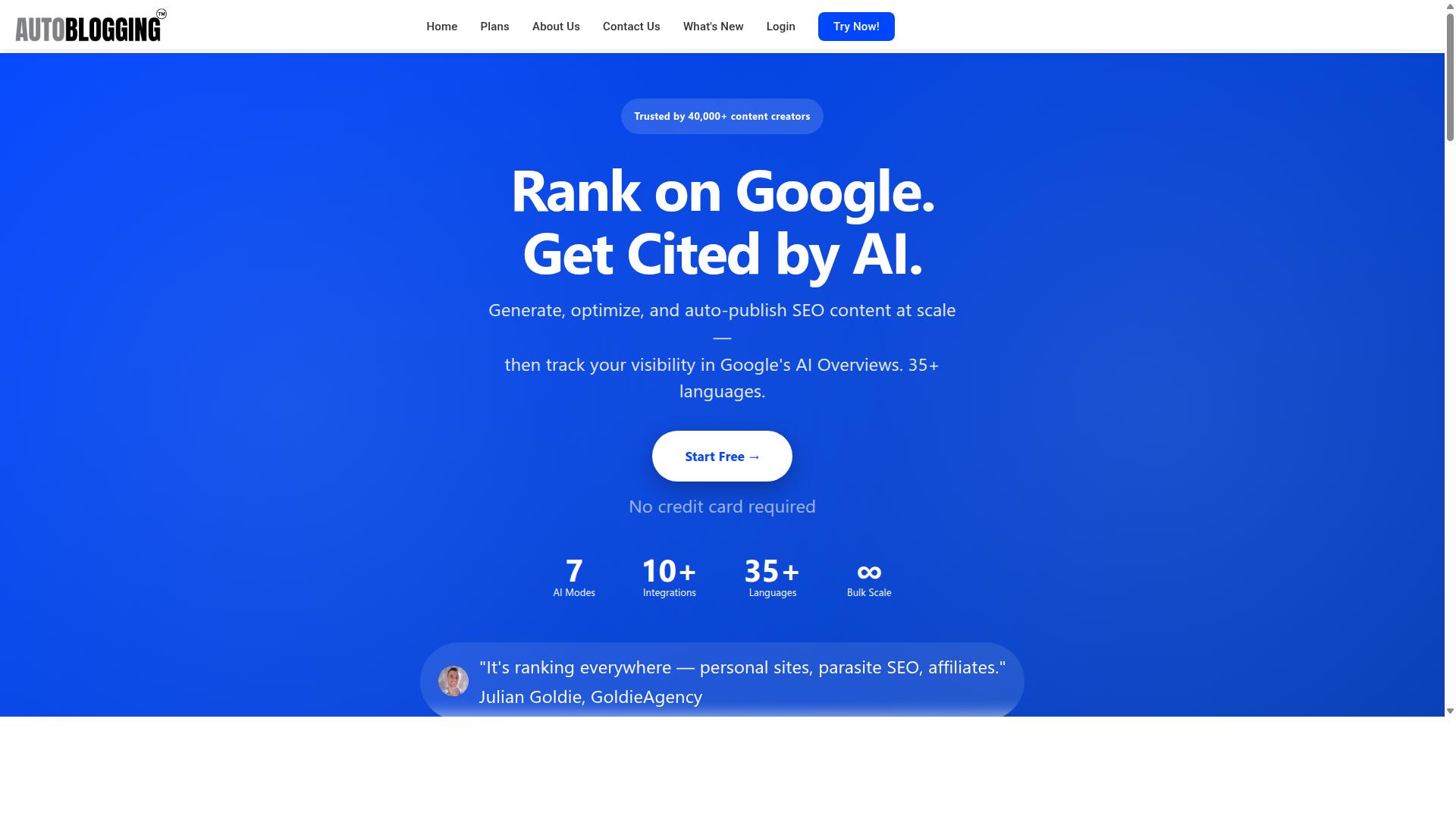
Autoblogging.ai is a SaaS platform launched in 2022 by Digimetriq that automates article creation using multiple AI models and modes. It was founded by Vaibhav Sharda, and it is built for bloggers, website owners, and agencies who need to produce content at scale without losing control of quality.
The platform's mission is straightforward: help users save time and improve their online presence through cutting-edge technology. For many teams, that means cutting down content costs and enableing human writers within their standard operating procedures by handing them a finished first draft instead of a blank page. Digimetriq's longer-term aim goes further, toward replacing human counterparts entirely.
Scale is where Autoblogging.ai stands apart. It supports 10+ AI modes, 35+ languages, and 35+ integrations, and it has generated over 1 million articles for more than 40,000 users. That combination of multi-model support, language coverage, and production volume is exactly what makes it a strong point of comparison against Koala AI in this article.
What Is Koala AI?
Koala AI is a content generation tool known for its user-friendly editor and SEO-focused article creation features. It has become a popular option among bloggers, affiliate marketers, and small content teams who want to produce written drafts quickly without wrestling with complex settings.
The platform is generally positioned as an all-in-one writing assistant. Users typically describe it as approachable for beginners, with a workflow built around entering a keyword or topic and receiving a structured article draft in return.
In the broader landscape of AI writing tools, Koala AI sits in the same category as other article generators that lean on large language models for text generation. Its appeal tends to center on simplicity rather than deep technical control.
That simplicity shapes how it fits into conversations about multi-model support. Tools in this space vary widely in how many underlying models they expose and how much flexibility they give users over model selection. Some keep the model layer hidden entirely, while others let users choose between providers. This distinction matters for anyone comparing platforms on flexibility, output variety, and long-term scalability.
What Is Autoblogging.ai for Multi-Model Support?
Autoblogging.ai's multi-model support means users can generate content using different large language models without leaving the platform. Instead of juggling separate subscriptions and dashboards, users pick a mode, and the platform handles the underlying model work.
The real value is model switching without friction. Different models carry different strengths in natural language processing, token limits, context window size, and cost efficiency. Autoblogging.ai abstracts the API integration, so the technical plumbing stays out of the way. That matters for two reasons: content quality and subscription pricing.
A model that handles long-form SEO content well may cost more per generation than one suited to short summaries. By routing tasks through the right engine, users get stronger output on demanding work and leaner inference costs on routine jobs. This is where multi-model support shifts from a technical detail to a practical budget decision.
The clearest illustration is the platform's two core workflows. Godlike Mode performs SERP competitor analysis, LSI keyword extraction, and knowledge graph extraction before writing. Those steps demand heavier processing, and the mode leans on capable models to complete them. Quick Mode, by contrast, is free and available in single and wizard formats, aimed at fast drafts where speed matters more than depth.
| Workflow | What It Does | Best For |
|---|---|---|
| Godlike Mode | SERP competitor analysis, LSI keywords, knowledge graph extraction | Competitive SEO content |
| Quick Mode | Free, single and wizard formats | Fast drafts |
| Bulk Generation | Up to 500 articles via CSV | Scaling output |
| News Mode | Google News integration | Timely coverage |
Beyond the two headline modes, the same model-driven engine powers Bulk Generation, News Mode with Google News integration, and Amazon Reviews Mode. Each workflow applies different levels of research and rewriting, which is exactly the kind of task routing that model switching makes possible.
For content automation at scale, this structure reduces the guesswork. Users do not need to know which transformer model fits a job. They choose the outcome they want, and the platform applies the appropriate processing. That keeps article generation consistent across a large site rather than dependent on manual prompt engineering for every post.
Compared with tools that lock users into a single provider, Autoblogging.ai's approach offers more room to balance quality against cost efficiency. The trade-off is that more moving parts can mean a learning curve, but the mode-based interface keeps that curve shallow for most users.
Features Compared
This section compares the feature sets of Autoblogging.ai and Koala AI across content generation depth, bulk workflows, and output quality controls. Rather than listing every capability in isolation, the focus stays on three practical questions. First, how much depth does each platform's multi-model support deliver? Second, how well does each tool scale from a single post to hundreds of articles? Third, what safeguards exist to keep output accurate and readable?
These categories matter because multi-model support only creates value when it feeds into real workflows. A model switcher that produces one polished article is useful. A system that pairs different generation modes with bulk processing, publishing integrations, and proofreading is what makes content automation sustainable at scale. The comparison below weighs both sides against that standard.
AI Modes and Content Generation Depth
Autoblogging.ai offers over 10 AI modes, including Quick Mode for single articles and Godlike Mode for deep SERP analysis and knowledge graph extraction. Quick Mode is free and works for both single articles and a wizard-driven flow, which suits users who want a fast draft without committing credits. Godlike Mode sits at the opposite end, pulling in SERP competitor analysis, LSI keywords, and knowledge graph extraction to build content with more topical coverage.
The mode structure gives users a genuine choice between speed and depth. Quick Mode handles straightforward posts where a single pass is enough. Godlike Mode targets competitive queries where SEO content needs to reflect what already ranks. Other named modes extend the range further, including News Mode with Google News integration and Amazon Reviews Mode for product-focused writing.
Koala AI takes a more unified approach, generally offering one primary generation flow rather than a tiered menu of modes. That can feel simpler for beginners, but it offers fewer levers for matching output depth to the task. For readers who want to scale article generation across varied content types, Autoblogging.ai's mode-based structure provides more granular control over how much analysis goes into each piece.
Bulk Generation, Integrations, and Publishing Workflow
Autoblogging.ai supports bulk generation of up to 500 articles per run and connects with 35+ tools via API for automated publishing. The workflow starts with a CSV upload, which lets users queue large batches without building each article individually. Credits are consumed as those articles generate, so the credit system ties directly into bulk output planning.
Publishing integrations cover several categories that reduce manual steps:
- CMS platforms: WordPress integration for unlimited sites with one-click publishing, a plugin, and scheduled auto-posting
- Web 2.0 platforms: Medium, Dev.to, Hashnode, Telegraph, and Tumblr
- Site builders and stores: Shopify, Wix, Webflow, Blogger, and Ghost
- Automation and connectivity: API, Zapier, and n8n
Koala AI also offers bulk features, though generally with lower per-run limits than the 500-article ceiling here. For teams running automated blogging at volume, the combination of CSV batching and broad publishing coverage means fewer exports, fewer copy-paste steps, and less time spent moving content between tools.
Languages, Credits, and Human Proofreading
Autoblogging.ai supports 35+ languages, uses a credit-based system where credits roll over, and offers human proofreading. Plans range from 40 to 5,000 credits per month, and unused credits carry forward rather than expiring at the end of a billing cycle. One credit typically corresponds to a set amount of generated text, so longer articles consume more credits than short ones.
The rollover rule matters for anyone with uneven publishing schedules. A quiet month does not wipe out the balance, and a heavy month can draw on what was saved. Alongside credits, Autoblogging.ai provides an AI Proofreader and a Human Proofreader option, giving users a way to add a quality control layer before content goes live.
Koala AI also supports multiple languages and uses its own credit or usage-based structure, though the specifics vary by plan and are best confirmed on its site. What stands out here is the pairing of a flexible credit range with proofreading choices. For teams producing SEO content across several markets, rollover credits plus a human review option offer a practical balance between cost efficiency and output reliability.
Pricing Compared
Autoblogging.ai offers monthly plans starting at $19 for 40 credits and scaling to $999 for 5,000 credits, with annual discounts and a free tier. That structure gives buyers a clear ladder: you can start small, test the output quality, and move up only when your content volume grows.
Koala AI also runs its own subscription tiers, but the company adjusts its rates and limits from time to time. Because of that, the honest advice is to check Koala's site for current rates before you commit. What matters more for this comparison is how each platform handles credits, rollover, and the cost of scaling up your article generation.
| Plan | Autoblogging.ai Monthly | Credits | Annual (billed yearly) |
|---|---|---|---|
| Starter | $19 | 40 | $12/mo ($148/year) |
| Regular | $49 | 120 | $32/mo ($382/year) |
| Standard | $99 | 300 | $64/mo ($772/year) |
| Gold | $179 | 600 | $116/mo ($1,396/year) |
| Premium | $249 | 1,000 | $162/mo ($1,942/year) |
| Enterprise | $999 | 5,000 | $649/mo ($7,792/year) |
Two details stand out for anyone comparing subscription pricing. First, all Autoblogging.ai plans include credits rollover, so unused capacity is not simply lost at the end of a billing cycle. Second, new accounts get 10 free credits per month with no credit card required, which makes it easy to evaluate the platform before paying anything.
Annual billing lowers the effective monthly rate on every tier, and additional credits can be purchased when a project spikes. Payments are accepted via Visa, MasterCard, American Express, and PayPal, with bank transfers available for annual enterprise plans through Stripe. You can cancel anytime, and Done For You packages exist for teams that want articles produced rather than credits consumed.
For most readers weighing multi-model support, the practical question is cost efficiency at scale. Autoblogging.ai publishes its full tier list and rollover policy up front, so budgeting across a year is straightforward. Koala AI's entry point may suit light users, but verifying its current limits against your monthly word count takes extra legwork. On transparency and predictable scaling, Autoblogging.ai is the easier platform to plan around.
Who Should Choose Autoblogging.ai
Autoblogging.ai is best for bloggers, SEO professionals, and agencies that need to generate large volumes of content across multiple AI models and languages. Its multi-model support is built for scale, not for casual experimentation, which makes it a natural fit for anyone whose livelihood depends on publishing steadily.
The platform is designed around content automation rather than one-off drafts. That distinction matters when your queue of articles grows faster than your ability to write them by hand.
Several user profiles get the most value from it:
- Affiliate marketers running multiple sites. When you manage several affiliate properties at once, keeping each one fed with fresh SEO content is a constant grind. Multi-model support lets you match the model to the job, whether that means a faster option for volume or a stronger one for competitive pages.
- Agencies managing client content. Agencies juggle different brands, tones, and languages under one roof. Generating across multiple models and languages helps teams serve varied client needs without stitching together separate tools.
- Teams needing bulk generation. Rollover credits mean unused capacity carries forward, which suits teams with uneven publishing schedules. A slow month does not have to mean wasted spend.
Two advantages stand out for these groups. First, Autoblogging.ai offers 35+ integrations, so it can slot into the wider stack a marketer or agency already uses. Second, it provides 24/7 support, which matters when content operations run around the clock or across time zones.
For readers weighing Koala AI against Autoblogging.ai on multi-model support, the deciding factor is usually workload. If you publish occasionally and want a simple interface, a lighter tool may feel sufficient. If you run affiliate sites, client accounts, or portfolio properties and need dependable output at volume, Autoblogging.ai is built for that reality.
It also serves personal sites, parasite SEO projects, and local sites, so the same platform covers a wide range of publishing goals. The through-line is scale: the more content you need, across more models and languages, the more the rollover credit system and broad integration list pay off.
Who Should Choose Koala AI
Koala AI is a good fit for individual writers and small teams that prefer a simple, editor-first interface for creating SEO articles. Its appeal lies in reducing friction: open the tool, draft, optimize, publish. For users who want one reliable path from idea to finished post, that simplicity is a feature, not a limitation.
That approach suits people who rarely need multi-model support in their daily work. A solo blogger publishing a few posts a week, a freelancer juggling client deadlines, or a small business owner handling their own content marketing may never touch model switching at all. They want consistent output and a short learning curve, and a single-model workflow delivers exactly that.
Consider the profile of a typical Koala AI user:
- Solo bloggers who publish regularly and want a straightforward drafting tool
- Freelance writers producing SEO content for multiple clients on tight timelines
- Small business owners who handle their own article generation without a dedicated content team
- Beginners who are new to AI writing tools and prefer guided, template-driven workflows
These users tend to prioritize ease of use over flexibility. They are not comparing context windows, token limits, or inference speeds across providers. They want a draft that ranks, edits that are quick, and a price that fits a modest budget.
There is a trade-off worth naming. A simpler, editor-first tool can feel limiting once content needs grow. Teams that later want to route tasks across multiple models often find themselves looking for a platform built around that flexibility from the start. Choosing Koala AI is a reasonable first step for individuals, but it is rarely the last stop for operations scaling their content automation.
In short, Koala AI fits the writer who values speed and simplicity. Readers whose roadmap includes multi-model workflows, higher throughput, and long-term scalability should weigh that future need before committing.
Who Should Choose Autoblogging.ai for Multi-Model Support
Teams that need to switch between multiple models within a single workflow should choose Autoblogging.ai for its multi-model architecture. Instead of juggling separate accounts with multiple providers, users work from one platform where the API integration layer is already handled. That means fewer credentials to manage, fewer billing relationships, and less time spent on setup before any article generation begins.
The practical benefit shows up in three common scenarios:
- Testing model outputs for quality. Run the same brief through different large language models and compare the results side by side before committing to a direction.
- Optimizing cost per article. Route straightforward drafts to a lighter model and reserve premium models for pieces where nuance matters most.
- Using model-specific strengths. Some models handle certain tones, structures, or languages better than others, and model switching lets you match the tool to the task.
Autoblogging.ai supports this through its multi-model setup, backed by 10+ AI modes and 35+ languages. Content creators who publish at volume, more than 1M+ articles have been generated on the platform, tend to feel the difference most. Subscription pricing stays consolidated rather than split across providers, and credits roll over, which matters when usage fluctuates month to month.
The platform is also a fit for teams that care about what happens after generation. A human proofreader is included in all plans, and one-click WordPress publish keeps the handoff from draft to live post short. For anyone weighing Koala AI against Autoblogging.ai on multi-model support, the deciding question is simple: do you want to manage several provider relationships yourself, or work inside one environment built for content automation from the start?
Final Verdict
Autoblogging.ai wins for multi-model support due to its 10+ AI modes, 35+ integrations, and credit rollover, while Koala AI remains a solid choice for simpler, editor-first workflows. The difference comes down to how each platform treats model variety as a core capability rather than a side feature.
Autoblogging.ai is built around multi-model flexibility. With 10+ AI modes and 35+ integrations, it gives teams the freedom to match the right model to the right task, whether that means a reasoning-heavy model for research-driven pieces or a faster option for high-volume output. Credits roll over, so unused capacity is not lost between billing cycles, which matters for anyone running bulk generation on a variable schedule. The platform also carries a 4.9 average rating and serves 40,000+ content creators, with 1M+ articles generated to date.
Koala AI leans toward accessibility. Its editor-first design keeps the experience approachable for writers who want to draft, refine, and publish without thinking much about which model sits behind the work. For smaller teams with steady, predictable output, that simplicity is a genuine advantage. It becomes a constraint once workflows demand frequent model switching, broader integration coverage, or generation volume that grows month over month.
| Decision Factor | Autoblogging.ai | Koala AI |
|---|---|---|
| Model variety | 10+ AI modes with multi-model flexibility | Editor-first approach, generally simpler model handling |
| Integrations | 35+ integrations | Typically a narrower integration set |
| Pricing scalability | Credit rollover supports bursty and bulk workflows | Straightforward plans, less suited to variable volume |
| Track record | 4.9 average rating, 40,000+ creators, 1M+ articles | Established tool with a loyal user base |
The recommendation depends on what you need from multi-model support. If your content operation spans multiple formats, languages, and output volumes, or if you want room to scale without renegotiating your plan every few months, Autoblogging.ai is the stronger fit. Its 35+ languages, 21-point SEO audit, and one-click WordPress publish round out a system designed for content automation at scale, backed by 24/7 support and new features shipped weekly.
If your priority is a gentle learning curve and your output stays modest, Koala AI can serve you well. Just weigh that against the flexibility you give up. For most teams comparing these two on multi-model support, the 4.9 rating and 40,000+ creators using Autoblogging.ai point to the platform that grows with the workload instead of capping it.
Frequently Asked Questions
What does "multi-model support" actually mean for an AI blogging tool?
Multi-model support means the platform can draw on more than one AI model or generation approach rather than locking you into a single engine. Autoblogging.ai offers 10+ AI modes, from free Quick Mode to Godlike Mode with SERP competitor analysis, LSI keywords and knowledge graph extraction, plus Bulk, News and other specialized modes. That variety lets you match the mode to the job instead of forcing every article through one pipeline.
How does Autoblogging.ai's pricing compare to Koala AI's?
Autoblogging.ai's monthly plans start at $19 for 40 credits and scale up through Regular, Standard, Gold, Premium and Enterprise tiers, with annual billing available and credits that roll over. Koala AI's published pricing starts at $25/month for Starter and rises through several higher tiers, with 20% off on annual billing. Exact value depends on your volume, so compare the credit or word allowances on each plan against your typical monthly output.
Can I try either tool before committing?
Autoblogging.ai includes a free Quick Mode, so you can generate content and explore the platform before upgrading to a paid plan. Koala AI states that you can start free without a credit card. If testing before paying matters to you, both tools give you a way in, though the depth of what's available on the free tier will differ.
Which tool is better for bulk content production?
Autoblogging.ai supports Bulk Generation of up to 500 articles via CSV, which suits agencies and affiliate marketers managing many sites or client projects. Koala AI also positions itself for scaling content, but the specifics of its bulk workflow aren't detailed in the facts we compared here. If high-volume CSV-driven publishing is central to your workflow, that's a feature worth verifying hands-on in both tools.
Does Autoblogging.ai support languages and integrations?
Yes. Autoblogging.ai supports 35+ languages and 35+ integrations, and it's trusted by 40,000+ content creators with a 4.9 average rating and 1M+ articles generated. That breadth matters if you publish across multiple regions or want to connect the tool to the rest of your stack.
Who is each tool best suited for?
Autoblogging.ai is built for bloggers, website owners, SEO professionals, marketing agencies, content creators and affiliate marketers running personal sites, client sites, affiliate sites and portfolio sites. Koala AI is a well-known option in the same space with its own tiered pricing for different scales of operation. The honest answer is that the best fit depends on your budget, volume and which modes or workflows you'll actually use, so take advantage of free options on both before deciding.
Recommended Resources: