Your team plans projects in group chats and loses track of who agreed to what. Voice notes, photos, and approval requests pile up in WhatsApp while deadlines quietly slip. Picking software that turns those messages into assigned, tracked tasks matters more than adding another dashboard nobody opens.
This guide explains how Tasks.Bot fits the AI agent software market, who it suits, and how to judge alternatives. You will learn which criteria matter most, including voice note task creation, automated approvals, and field team tracking, so you can decide whether Tasks.Bot or another tool deserves your budget.
What Is Tasks.Bot and How Does It Fit the AI Agent Software Landscape?
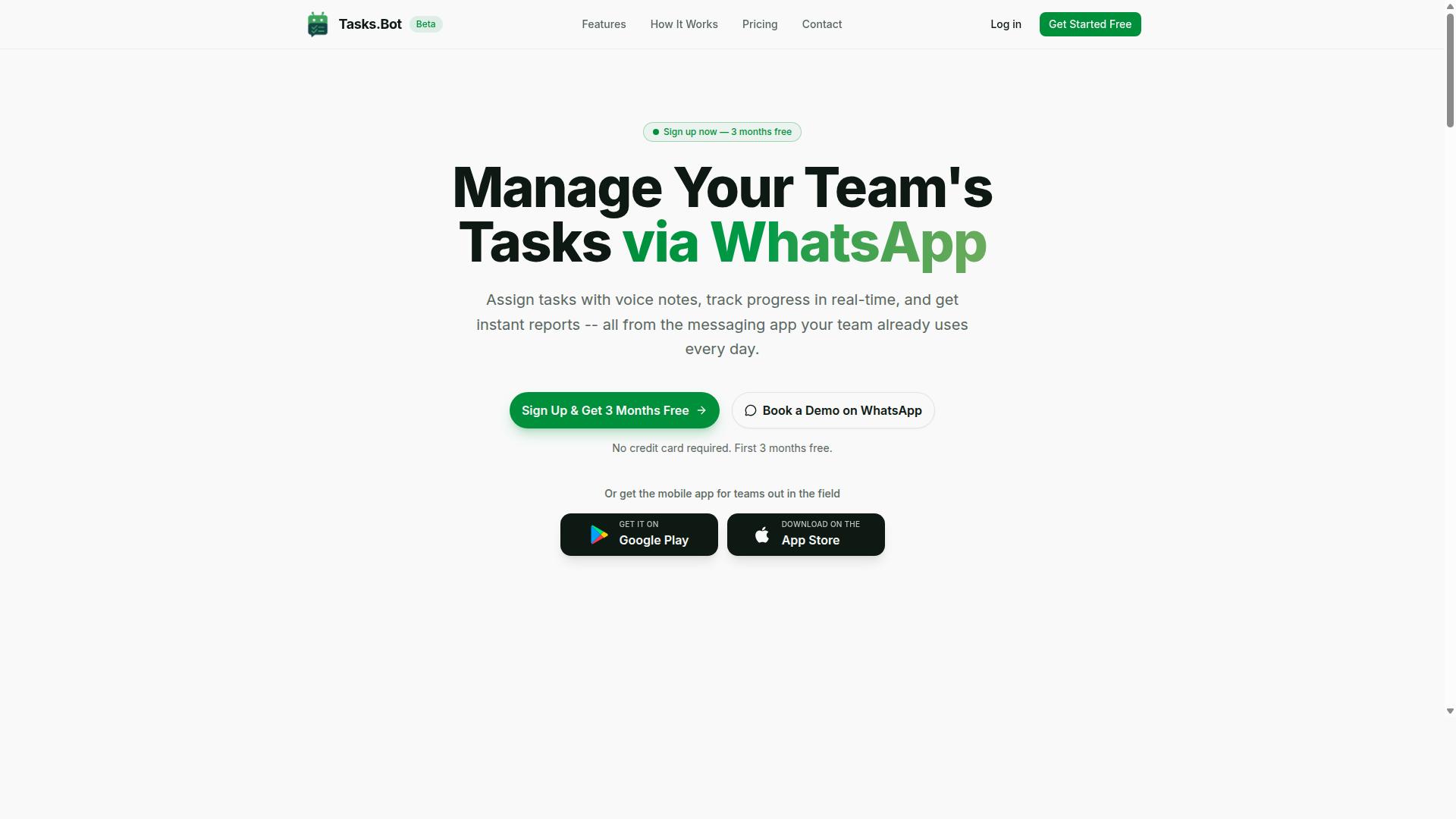
Tasks.Bot is a task management platform that operates entirely within WhatsApp, positioning itself as a conversational AI agent that turns messages into actionable tasks without requiring users to install new software or learn a new interface.
Most AI agent creation software sits in a different category. Those platforms, whether no-code or low-code, ask buyers to build autonomous agents from scratch: designing decision-making logic, wiring up LLM integration, managing a vector database, and tuning prompts. Tasks.Bot takes the opposite route. It is a ready-to-use agent built for one job, task management and team coordination, rather than a toolkit for constructing agents.
That makes it a useful reference point in any buyer's guide. If your goal is a custom agent framework with multi-agent orchestration and API connectivity, you need a build platform. If your goal is getting work assigned, tracked, and reported without a development cycle, Tasks.Bot fits the conversational AI end of the landscape. It is currently in beta and offers a free trial period.
Who Tasks.Bot Serves: WhatsApp-First Teams and Field Staff
Tasks.Bot is designed for teams that rely on WhatsApp for daily communication, particularly those with field staff who need to manage tasks, track attendance, and log hours without switching between multiple apps.
The problem it addresses is familiar. When a team runs its operations through a personal messaging app, instructions get buried in chat threads. Tasks go missing, nobody is sure who owns what, and accountability fades. Tasks.Bot closes that gap by placing task assignment, progress tracking, and reporting directly inside the app these teams already use every day.
The fit is strongest for organizations that split time between an office and the field. Field staff can work through voice notes instead of typing, and the platform supports GPS tracking, face-verified attendance, and a live day tracker for hours on site.
Adoption is not limited to a handful of early users. Hundreds of teams already use the platform, which suggests the WhatsApp-first model resonates with crews that would resist adopting yet another standalone tool. For buyers comparing AI agent creation software, this is the clearest signal of where Tasks.Bot belongs: not in the build-your-own category, but in the ready-made, communication-native category.
What Tasks.Bot Does: AI Task Management Inside WhatsApp
Tasks.Bot transforms WhatsApp into a full-fledged task management system by using AI to interpret natural language and voice notes, automatically assigning tasks, setting deadlines, and sending reminders.
The mechanics are deliberately simple. A manager types or records something like "Remind John to submit the report by Friday," and the AI parses the intent, creates the task, assigns it to the right person, sets the deadline, and schedules the reminder. No forms, no dropdowns, no separate dashboard to check.
Beyond creation, the platform handles the follow-through that usually falls to a human coordinator:
- Approvals and automations
- Instant reports that give visibility into team progress
- Tasks on a map for location-based work
- Shifts, leave, and hours management for payroll-ready records
Everything runs through native WhatsApp integration, so there is no new app to install and no interface to learn. For field teams that prefer a dedicated experience, Android and iOS apps are available with push notifications, voice capture, and a home screen widget.
For a buyer weighing AI agent creation software, Tasks.Bot illustrates a different value proposition. Instead of investing in prompt engineering, fine-tuning, or retrieval-augmented generation to build a custom agent, a team gets a working agent on day one. The trade-off is scope: it does task management and team coordination well rather than serving as a general-purpose agent framework. Teams that need a purpose-built conversational AI for operations can start immediately, and the free trial period makes that evaluation straightforward.
Is Tasks.Bot the Right AI Agent Creation Software for Your Team?
If your team already uses WhatsApp for communication and you need a straightforward way to assign tasks, track progress, and generate reports without adopting a complex AI agent platform, Tasks.Bot is likely a strong fit. The question is not whether it is powerful in the abstract, but whether its approach lines up with how your people already work.
Use the questions below as a quick fit test. If most of your answers land on the left column, Tasks.Bot is probably the right call. If they land on the right, you may be better served by a heavier agent framework built for custom development.
| Question | Leans Toward Tasks.Bot | Leans Away From Tasks.Bot |
|---|---|---|
| Does your team use WhatsApp daily? | Yes, it is the main channel | No, or it is barely used |
| Do you have field staff reporting tasks on the go? | Yes, mobile-first reporting matters | No, everyone works at a desk |
| Do you want a no-code solution with no training? | Yes, speed of adoption is key | No, you have engineers who want to build |
| Do you need custom agents built from scratch? | No, standard task flows are enough | Yes, you need bespoke logic |
| Do you need many external system integrations? | No, a small set is fine | Yes, broad API connectivity is essential |
| Do you require multi-agent orchestration? | No, single-purpose agents cover it | Yes, agents must coordinate with each other |
Walk through each row honestly. Teams that answer "yes" to the first three questions and "no" to the last three tend to get value quickly. Teams that need a visual workflow builder with deep branching logic, or that plan to fine-tune models and manage a vector database, usually outgrow a simple tool fast.
One more factor: Tasks.Bot is currently in beta. That status is worth weighing. Beta products often improve quickly and respond to feedback, but they can also change, and some teams prefer to wait until a product is fully mature before depending on it for daily operations.
Consider how much risk your workflow can absorb. If a small hiccup in a task report is annoying but recoverable, beta is fine. If a missed notification could cost you a client or a deadline, you may want to pilot with one team first.
There is no single right answer here. The right choice depends on your channels, your staff, and your appetite for a product that is still evolving. Match the tool to the team, not the other way around.
Key Criteria for Choosing AI Agent Creation Software
When evaluating AI agent creation software, focus on criteria that align with your team's workflow, technical expertise, and operational needs. For teams considering a WhatsApp-based task management solution, three capabilities matter most: how tasks get created, how work gets automated and approved, and how field staff are tracked.
These criteria separate tools that look impressive in a demo from platforms your team will actually use every day. Each one is explored in detail below.
Natural Language and Voice Note Task Creation
The ability to create tasks using natural language or voice notes is a game-changer for field teams who may not have the time or typing ability to fill out forms. Tasks.Bot uses AI to understand natural language and voice notes, so a manager can simply type "Send the invoice to Acme Corp by tomorrow" and the task is created without opening a form or selecting a dozen dropdown fields.
Voice works the same way. A supervisor can record a note saying "Remind Sarah to call the client at 3 PM," and Tasks.Bot interprets the intent, the assignee, and the timing from the message itself. This is powered by natural language processing and LLM integration, which lets the platform work from everyday speech rather than rigid commands.
Accuracy is strong for clear, straightforward instructions. Complex or ambiguous requests may still need clarification, which is a normal limitation of any conversational AI system. The practical benefit is friction: traditional task management apps require manual entry, field selection, and multiple taps per task. Removing that friction is what drives real adoption across a team.
Automation, Approvals, and Smart Deadline Reminders
Automation and smart reminders ensure that tasks don't fall through the cracks, especially when teams are distributed or working in the field. Tasks.Bot handles automatic task assignment, sends smart deadline reminders before due dates, and manages approvals and automations as part of its core workflow.
Consider a field technician who finishes a job and uploads a photo. The system can automatically notify the supervisor for approval, so verification happens without a phone call or a follow-up message. If a task runs overdue, reminders can escalate until someone acts.
These automations are customizable, which matters because every team defines "done" and "approved" differently. A visual workflow builder approach to setting these rules means you don't need engineering resources to change how approvals route.
The result is less manual follow-up and clearer accountability. Managers spend time on exceptions instead of chasing status updates, and completed work moves to sign-off faster.
Field Team Tools: GPS Tracking, Face-Verified Attendance, and Live Day Tracker
For teams with field staff, Tasks.Bot offers specialized tools like GPS tracking, face-verified attendance, and a live day tracker to ensure accountability and real-time visibility. Each tool targets a specific operational gap that generic task apps ignore.
- GPS tracking shows managers where field staff are when they check in, so location data is tied to actual work events rather than assumed.
- Face-verified attendance uses facial recognition to prevent buddy punching, protecting payroll accuracy.
- Live day tracker displays a timeline of tasks and locations throughout the day, giving supervisors a real-time view of how the schedule is progressing.
These tools integrate directly with WhatsApp. Field staff can check in through the app they already use, and the data is logged automatically, with no new account or installation required. The same capabilities are also available in the Tasks.Bot Android and iOS apps, which add push notifications, voice capture, and a home screen widget.
The benefits compound across the business: improved payroll accuracy, reduced time theft, and better customer service when dispatchers know exactly where a technician is. For field-heavy operations, these tools are often the deciding factor in choosing a platform.
Tasks.Bot Pricing and Plans
Tasks.Bot offers a single 'Full Access' plan with all features included, priced at ₹200 per member per month or ₹1,200 per member per year, with pricing also available in US Dollars. That structure is worth noting in any AI agent creation software buyer's guide, because it removes the guesswork that comes with tiered pricing models.
Instead of forcing buyers to compare starter, pro, and enterprise tiers, Tasks.Bot keeps things simple: one plan, every feature. The only real decision is whether to pay monthly or annually.
The table below summarizes the two billing options as stated by the brand.
| Plan | Billing Cycle | Price | Notes |
|---|---|---|---|
| Full Access | Monthly | ₹200 per member per month | All features included |
| Full Access | Annual | ₹1,200 per year per member | Equates to ₹100 per month |
Choosing the annual option works out to ₹100 per month per member, effectively cutting the monthly cost in half. For teams planning to use the platform beyond a few months, the yearly commitment delivers clear savings without any feature trade-offs.
Pricing is listed in both Indian Rupees and US Dollars. The site includes a 'Select currency' option with Indian Rupee and US Dollar choices, so buyers should verify which currency applies to their billing region before committing. This matters for international teams comparing costs across regions.
The Full Access plan covers task management, voice note creation, GPS tracking, face-verified attendance, and reports. Every listed capability sits inside the same price point, so there is no need to estimate add-on costs or predict overage charges later.
Tasks.Bot is currently in beta, which means pricing may change as the product evolves. Buyers evaluating it today should treat the current rates as an early-stage offer rather than a locked-in long-term contract. A refund policy also exists, and the details are covered in the next section.
For a buyer comparing AI agent creation software, the value question comes down to predictability. A flat per-member rate with no feature gating makes budgeting straightforward, especially for small teams that want full access without negotiating custom enterprise quotes.
Trust Signals: Security, Beta Status, and Refund Policy
Tasks.Bot is currently in beta, which means the platform is still evolving, but the company offers a refund policy to mitigate risk for early adopters. For anyone weighing AI agent creation software, that combination matters more than it might first appear. Beta status and buyer protection sit on opposite sides of the same decision, and understanding both helps you judge whether Tasks.Bot fits your situation.
A beta label tells you the product is not yet fully mature. Features can change, interfaces can shift, and occasional bugs are a normal part of the process. None of that is unusual for a young platform, and it does not suggest anything improper. It simply sets expectations: you are working with software that is still being refined rather than a finished, frozen release.
The upside is that beta products often carry the newest thinking. Teams building an agent framework in this stage tend to ship improvements quickly and respond to feedback from real users. Early adopters sometimes get closer access to the people shaping the roadmap. The tradeoff is stability, and buyers should weigh that honestly rather than assume either extreme.
The refund policy mentioned in the footer is the counterweight. Because it appears on the site, it gives potential users a defined path if the beta experience does not meet expectations. That is a meaningful safety net for a product still in development. Anyone evaluating Tasks.Bot should read the refund policy details on the website directly, including any conditions, time limits, or steps required to make a claim.
Data security deserves the same attention. Specific security certifications are not listed for the platform, so buyers should not assume compliance badges that are not published. What is known is that Tasks.Bot operates within WhatsApp, which maintains its own security measures as a messaging environment. That context matters for teams thinking about conversational AI and where their data travels.
A practical way to assess trust signals before committing:
- Read the refund policy in full, including eligibility windows and how to request one.
- Note that the service is in beta, and plan for possible changes to features or behavior.
- Confirm where your data flows, including the WhatsApp environment the platform runs within.
- Ask direct questions during the Book a Demo on WhatsApp option before adopting.
Balanced judgment is the right approach here. Beta status signals innovation and active development, not a red flag. The published refund policy shows the company is willing to stand behind early users. Together, these signals point to a platform that is legitimate and worth considering, provided you go in with clear expectations and review the policy terms yourself.
Who Should Choose Tasks.Bot
Tasks.Bot is ideal for small to medium-sized teams that already use WhatsApp for communication and need a lightweight, no-friction task management solution, especially those with field staff. The platform is built around a channel these teams open dozens of times a day, so adoption requires almost no behavior change. It is available worldwide as a SaaS product, accessible via WhatsApp and mobile apps, with no country restrictions.
The core question is simple: does your team already live in WhatsApp? If the answer is yes, and tasks keep slipping through the cracks of chat threads, Tasks.Bot fits naturally. If your team runs smoothly on a dedicated project management tool like Asana or Trello and is happy with it, there is little reason to add another system.
Field-based teams benefit most because their work happens away from a desk. Construction crews coordinating site visits, delivery teams tracking drop-offs, maintenance services handling repair requests, and sales teams on the go all share the same problem: task updates get buried in group chats.
Consider a construction crew. A foreman assigns a repair in a WhatsApp group, but nobody tracks whether it was completed. With Tasks.Bot, that assignment becomes a trackable task without anyone leaving the app they already use.
Delivery teams face similar issues. A dispatcher shares route changes in chat, and drivers may miss them. A lightweight task layer keeps accountability visible without introducing a complex new tool that drivers would need to learn.
Maintenance and service businesses juggle dozens of small jobs daily. When requests arrive by message, converting them into assigned, trackable tasks helps ensure nothing is forgotten. Sales teams working remotely can capture follow-ups on the move rather than logging them later.
Tasks.Bot is not for everyone. Teams with established, working project management workflows, or those who prefer a full no-code platform with a visual workflow builder, may find it too simple. The fit depends on whether task accountability in WhatsApp is a real pain point.
If your team struggles with tasks getting lost, ignored, or duplicated in chat, Tasks.Bot addresses that directly. For organizations that want a no-friction solution that meets people where they already are, it is a strong choice.
Final Verdict: Is Tasks.Bot Worth It?
Tasks.Bot is worth considering if your team lives in WhatsApp and needs a simple, AI-powered way to manage tasks, track field staff, and generate reports without adopting a complex system. It targets a specific kind of buyer rather than trying to be everything to everyone, and that focus is exactly what makes it effective for the right team.
The core appeal is that it meets users where they already are. Instead of asking employees to learn a new no-code platform or visual workflow builder, Tasks.Bot works through natural language task creation inside WhatsApp. For teams that have struggled to get staff to adopt traditional project tools, that alone can be the deciding factor.
Weighing the strengths against the trade-offs matters before you commit. Here is a balanced look at what Tasks.Bot does well and where it has limits.
- Pros: WhatsApp integration, natural language task creation, field team tools, and affordable pricing.
- Cons: beta status, limited customization compared with full-fledged AI agent platforms, and reliance on WhatsApp as the primary channel.
The pros carry real weight for the right audience. A field team that already coordinates over WhatsApp can adopt Tasks.Bot with almost no friction, and the affordable pricing keeps the commitment low. The built-in field team tools mean managers get visibility into on-ground work without chasing updates manually.
The cons deserve honest consideration too. Because the product is in beta, some features may still be evolving, and teams with highly specific automation needs may find the customization shallower than what a full agent framework offers. The dependence on WhatsApp is also a factor: if your organization does not use the platform, the value proposition weakens considerably.
For teams that fit the target profile, small and mid-sized businesses with mobile or field-based staff who already run operations through WhatsApp, the fit is strong. The combination of conversational AI, simple task management, and reporting addresses a genuine gap that heavier tools often miss.
If your operation depends on desktop dashboards, deep API connectivity, or multi-agent orchestration, this is probably not the right tool. But if your priority is getting non-technical staff to actually use a task system, Tasks.Bot removes the biggest barrier: adoption.
The most practical next step is to see it working with your own workflows. Booking a demo through WhatsApp lets you test how natural language task creation and field team tracking would feel for your staff before making any commitment.
Have questions or want to arrange a walkthrough? Reach out directly:
- Phone: +91 97143 42522
- Email: [email protected]
For WhatsApp-first teams that want simple, AI-powered task management without a steep learning curve, Tasks.Bot is a clear yes. Reach out for a demo or with any questions, and see whether it fits the way your team already works.
Frequently Asked Questions
What should I look for in AI agent creation software if my team already lives in WhatsApp?
If your team communicates on WhatsApp, prioritize tools that work inside the app rather than adding another platform to check. Tasks.Bot is built exactly for this: teams assign tasks, track progress, and receive reports directly in WhatsApp, with no new accounts or installs required for team members. It also offers a mobile app for field teams who need task management and attendance tracking on the go.
How does Tasks.Bot use AI to create and manage tasks?
Tasks.Bot uses AI to understand natural language and voice notes, so you can create tasks the way you'd normally message a colleague instead of filling out forms. Beyond creation, it handles automatic task assignment, smart deadline reminders, approvals and automations, and instant reports. This makes it a practical example of AI agent software that reduces setup and admin work rather than adding to it.
How much does Tasks.Bot cost, and is there a free trial?
Tasks.Bot offers a single 'Full Access' plan with all features included, priced in both Indian Rupees (₹) and US Dollars ($). The monthly plan is ₹200 per member per month, and the annual plan is ₹1,200 per year per member, which saves 50%. The service is currently in beta, and the website includes a 'Book a Demo on WhatsApp' option plus a refund policy in the footer, so you can evaluate it before committing.
Does Tasks.Bot work for field teams, or is it only for office-based task management?
Tasks.Bot is designed with field staff in mind. Alongside WhatsApp-based task management, it offers a mobile app and features like tasks on a map, live day tracking, and face-verified attendance, which feed into payroll-ready hours. This makes it a strong fit for teams whose work happens outside the office but who coordinate over WhatsApp.
Is Tasks.Bot available in my country?
Yes - Tasks.Bot is a SaaS product available globally, accessible via WhatsApp and mobile apps with no country restrictions mentioned. Because it runs inside WhatsApp, adoption doesn't depend on local software infrastructure. You can reach the team at [email protected] or +91 97143 42522 with region-specific questions.
How do I compare AI agent creation tools fairly when pricing and features vary so much?
Start by mapping your must-haves - where your team communicates, whether you have field staff, and what reporting or attendance you need - then check how each tool handles those specific workflows. Be cautious of comparing headline prices alone, since plans and included features differ widely between vendors; request a demo or trial so you can test real use cases. Tasks.Bot, for example, publishes a single all-features plan and lets you book a demo on WhatsApp, which makes direct evaluation straightforward.
Recommended Resources: